Whether you're a law student, UPSC aspirant, advocate, or legal enthusiast, this channel is your go-to platform for in-depth legal knowledge and real-world case law analysis.
Beyond just responding to crime, a key function of the police is to proactively manage public life to prevent disorder. The Maharashtra Police Act, 1951, dedicates an entire chapter to this function, laying down several Police Regulations under Maharashtra Police Act. These are not internal rules for the police but are powers given to them to regulate the activities of the public in public spaces. This ensures a balance between individual freedoms and the community’s need for peace and safety.
This article provides a comprehensive guide to the important regulatory powers of the police, focusing on key sections that every law student must know.
Section 33: The Powerhouse of Public Regulation
Section 33 is the most extensive and frequently used section for Police Regulations under Maharashtra Police Act. It grants the Commissioner of Police and the District Magistrate the power to make rules to prevent obstruction, inconvenience, and risk to the public.
The key powers under Section 33 include:
1. Regulating Traffic
The police can make rules for all types of traffic on public streets, including:
- Prescribing lanes for different types of vehicles.
- Regulating the conditions under which vehicles may be parked.
- Controlling the movement of pedestrians and all other traffic.
- Regulating the number of passengers and goods in public transport.
2. Controlling Assemblies and Processions
This is a vital power for maintaining order. The police can regulate processions by:
- Directing the conduct and behaviour of persons in the procession.
- Prescribing the routes and the times at which processions may pass.
3. Licensing and Controlling Noise
To prevent public nuisance, Section 33 empowers the police to:
- License, control, or prohibit the use of loudspeakers, amplifiers, and music in any public place.
- Prohibit the beating of drums, tom-toms, and the blowing of horns or other sound instruments.
4. Ensuring Order in Public Places
The police can frame regulations for the conduct of people in places of public amusement or resort (like theatres, malls, and parks) to prevent overcrowding and disorder.
Section 36 & 37: Preventing Imminent Disorder
While Section 33 is for general regulation, Sections 36 and 37 provide powers to deal with more immediate threats to public peace.
Section 36: Power to Prohibit Specific Acts
An authorized police officer can issue a temporary order to prohibit certain acts for the prevention of disorder. These acts include:
- Carrying of arms, swords, spears, guns, or corrosive substances.
- Carrying of any articles that can be used to cause violence.
- Public utterance of cries, singing of songs, or playing of music that is deemed likely to cause a breach of the peace.
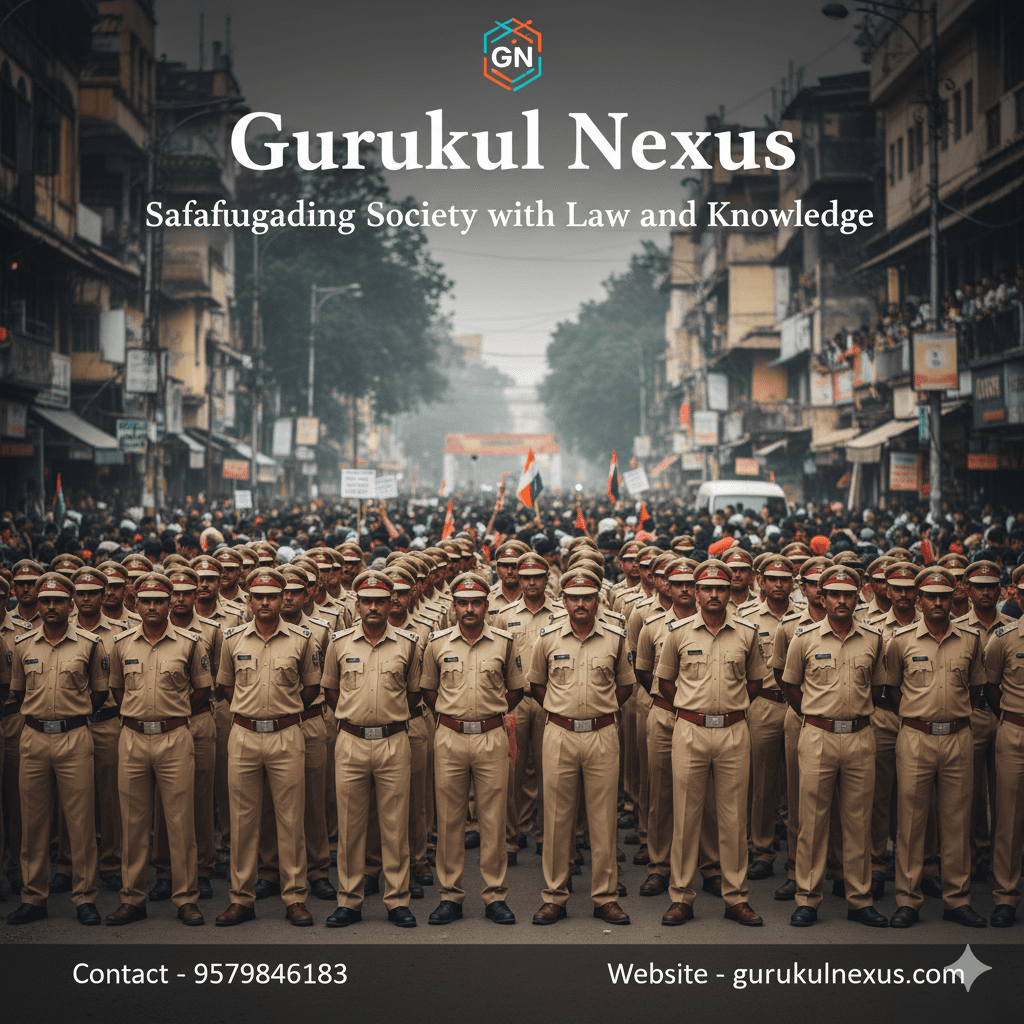
Section 37: Power to Prohibit Assemblies and Processions
This is a significant power used to maintain public order. The Commissioner or District Magistrate can issue a public order prohibiting any assembly or procession for a specific period if they believe it is necessary to preserve public peace or safety.
Note on BNSS (Formerly CrPC): This power is similar to the power under Section 163 of the Bharatiya Nagarik Suraksha Sanhita, 2023 (BNSS), which replaces Section 144 of the CrPC. However, Section 37 of the Police Act is a specific tool available to police and executive authorities to manage law and order in their jurisdictions.
Other Important Police Regulations
The Act includes several other regulatory duties that are crucial for day-to-day policing.
- Section 39 (Order on Public Roads): This gives a general power to police officers on duty to keep order on public roads, preventing obstructions and breaches of the peace.
- Section 41 (Enforcing License Conditions): If an assembly or procession violates the conditions of a license granted under Section 33, the police have the power to stop it and order the persons to disperse.
- Section 45 (Unclaimed Property): The police are required to take charge of all unclaimed property and issue a proclamation for any potential owner to come forward. This is an important public service regulation.
Relevant Case Laws ⚖️
- Himmat Lal K. Shah vs. Commissioner of Police, Ahmedabad (AIR 1973 SC 87)
- Facts: The petitioner challenged rules framed under the Bombay Police Act (the parent Act) which required prior permission from the police for holding any public meeting on a public street.
- Judgment: The Supreme Court delivered a landmark verdict, holding that the state has the right to regulate public assemblies but not the power to impose an arbitrary or absolute prohibition. The court struck down the rule requiring prior permission, clarifying that the Police Regulations under Maharashtra Police Act must be regulatory, not prohibitory, in nature, thus protecting the fundamental right to assemble peaceably.
- Gulam Abbas vs. State of U.P. (AIR 1981 SC 2198)
- Facts: The case involved a dispute between two religious communities over the performance of religious rites on a piece of land, leading to a recurring law and order problem.
- Judgment: The Supreme Court discussed the powers of the executive magistrate and the police to regulate public activities to prevent a breach of the peace. The principles laid down are vital for understanding how powers under Sections 33 and 37 of the Police Act should be exercised to manage sensitive religious processions and assemblies.
- Church of God (Full Gospel) in India vs. K.K.R. Majestic Colony Welfare Assn. (AIR 2000 SC 2773)
- Facts: A welfare association filed a complaint against a church for causing noise pollution through the use of loudspeakers during prayers.
- Judgment: The Supreme Court held that no religion prescribes that prayers should be performed by disturbing the peace of others through loudspeakers. It affirmed the power of authorities to regulate noise, which directly supports the police’s power under Section 33(1)(n) of the Maharashtra Police Act to control loudspeakers and other sources of noise.
Exam Point of View Notes 📝
- Most Important Section: Section 33 is a guaranteed question for exams. Remember to list its various powers (Traffic, Processions, Noise, Public Places).
- Key Distinction: Understand the difference between Section 36 (prohibits specific acts like carrying weapons) and Section 37 (prohibits the entire assembly or procession).
- Fundamental Rights Angle: Always mention that the regulatory powers of the police are subject to the fundamental rights of citizens (Article 19 – Freedom of Speech and Expression, Assembly). The regulations must be reasonable restrictions.
- Practical Application: These sections are the legal basis for everyday police work like traffic management, granting permission for festivals and rallies, and controlling noise levels.
Conclusion
The Police Regulations under Maharashtra Police Act, 1951, are essential tools that empower the police to be proactive custodians of public order. These provisions allow them to manage, guide, and, when necessary, restrict public activities to ensure that the fabric of civil life remains peaceful and orderly. For students and citizens alike, understanding these regulations is key to appreciating the complex role the police play in a democratic society.